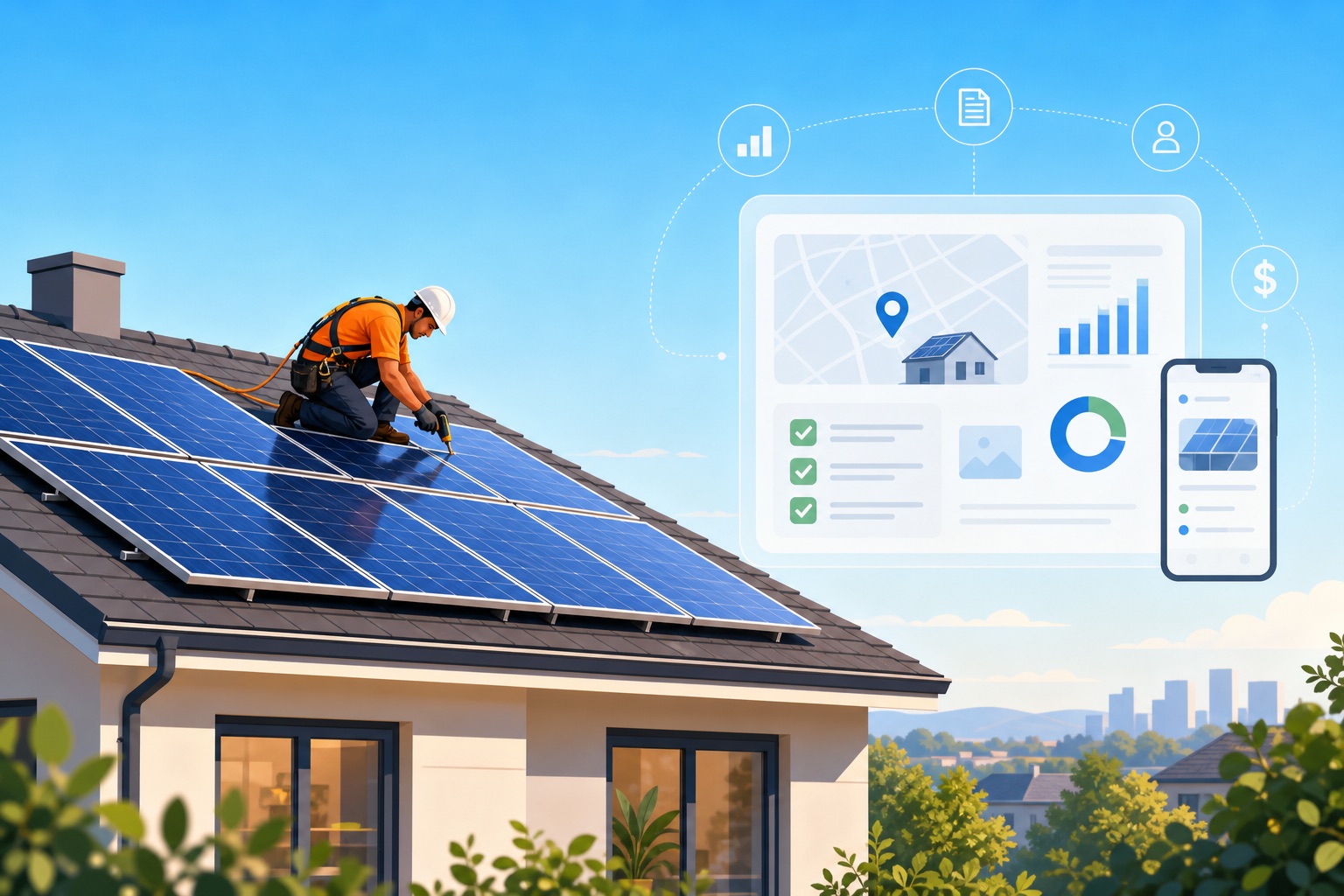
Aurora Solar occupies a well-defined lane in solar software: design and sales for residential and mixed-use installers that need accuracy, speed, and professional proposals under one subscription.
It does not try to be a full ERP, CRM, accounting platform, or field service management tool. It focuses on what happens before the truck rolls: roof modeling, PV system design, production estimates, sales proposals, shade reporting, battery sizing, and the documents that turn a design into a permit-ready package and signed contract.
This review looks at whether Aurora Solar delivers on that focus, where the costs add up, and who should - and should not - start a demo process.
Disclosure: Some links on Contractor Software Hub are affiliate links. If you sign up through one, I may earn a small commission at no extra cost to you. My recommendations do not change based on that.
Right for / Not for
Right for you if:
- You design and sell residential solar systems and need remote roof modeling from satellite and LIDAR data
- Your sales process depends on accurate production estimates, professional proposals, and shade analysis that prospects and financiers trust
- You are ready to invest in a paid platform and want published pricing rather than a “request a quote” process
- Your team works primarily on residential and mixed-use projects and values design accuracy and sales workflow over C&I capacity
- You need CRM integration (Salesforce, HubSpot) and want a path to API-driven customization as you grow
Not for you if:
- You are a solo operator or very small shop that needs a free design tool - OpenSolar is a better starting point
- Your primary work is commercial and industrial solar design above 1 MW - HelioScope is purpose-built for that
- You need an all-in-one operations platform with CRM, accounting, dispatch, and field service management
- Your project volume regularly exceeds 50 designs per month per designer and you cannot budget for additional licenses
Third-Party Rating: G2 users rate Aurora Solar 4.7 out of 5 based on 118 reviews. Capterra rates it 4.4 out of 5 from 60+ reviews. Across both platforms, reviewers consistently highlight ease of use, design accuracy, and customer support. The gap between G2 and Capterra scores likely reflects different reviewer populations: G2 skews toward sales and design professionals, while Capterra includes a wider range of operational roles. G2 is the primary source here because Aurora Solar’s strength is in design and sales workflow - the audience G2 captures best.
Feature Deep Dive
3D Roof Modeling from Satellite and LIDAR
Aurora Solar generates roof geometry from satellite imagery and, on the Premium tier, LIDAR point-cloud data. This means designers can model complex roof shapes - dormers, hips, valleys, obstructions - without a manual site visit. The LIDAR data improves accuracy to the point that roof measurements from the platform are trusted for permit applications and financing. For installers operating across multiple regions, this remote modeling capability eliminates the time and cost of physical site surveys for every proposal.
PV System Design and Production Estimates
The platform includes automatic panel layout, string sizing, inverter selection, and a component library of over 30,000 modules. Production estimates run hour-by-hour simulations incorporating weather data, shading, and system losses. This level of detail matters when a prospect asks “how much will I save” and the answer needs to hold up against a utility bill comparison. The accuracy claims are backed by the company’s engineering team and validated by the volume of installers using the platform for permit-ready designs.
Interactive Sales Proposals
Aurora generates branded, mobile-friendly proposals that include 3D walkthroughs, financing toggles (via integrations with Mosaic and GreenSky), and DocuSign e-signature capability. For sales teams, this means a prospect can view their own roof with panels placed, toggle financing terms, see estimated monthly savings, and sign - all from a tablet during a single appointment. This is the feature that most clearly distinguishes Aurora from engineering-focused tools that stop at the CAD drawing.
Shade Reporting with LIDAR (Premium)
The Premium tier adds LIDAR-assisted shade analysis that produces bankable shade reports. These reports are trusted by financing partners and can be the difference between a loan approval and a rejection. For installers in markets with significant tree coverage, challenging roof orientations, or HOA restrictions, the shade report is not a nice-to-have - it is the document that determines whether the system qualifies for financing.
Battery Modeling (Premium)
Premium includes battery sizing and performance projection for residential storage, including backup-power scenarios. As battery attachment rates continue to grow in residential solar, having battery modeling native to the design workflow - rather than a separate calculation tool - means fewer proposal revisions and a cleaner sales process.
What Aurora Solar Gets Right
Published Pricing in a Category That Hides It
Aurora Solar publishes its Basic ($159/user/mo) and Premium ($259/user/mo) pricing with clear project limits and feature breakdowns. This is surprisingly rare in solar design software. Competitors at similar price points often redirect buyers to a demo-and-quote process before revealing any numbers. Having a published starting point means installers can decide whether Aurora is in their budget range before investing time in a demo. The annual billing option ($1,620/year for Basic; $2,640/year for Premium) provides a path to lower effective monthly cost.
Design Accuracy That Reduces Site Visits
The combination of satellite imagery, LIDAR data, and automatic panel layout means most residential designs can be completed without a physical site visit. For a solar installer operating across a metro area or multiple states, this saves the most expensive resource: a skilled designer’s travel time. G2 reviewers consistently rate the platform’s accuracy as a core strength. When a design matches what the installer finds on the roof, it builds trust with both the sales team and the homeowner.
Sales-Proposal Integration
Aurora’s proposal builder is not an afterthought - it is a core part of the platform. The interactive 3D walkthrough, financing toggles, and e-signature capability mean a single tool handles design, proposal, and close. For contractors who previously moved between a design tool and a separate proposal builder, this consolidation is the primary reason to pay for Aurora rather than use a free design tool and a separate document system.
Company Stability and Customer Base
Founded in 2013, Aurora Solar has raised more than $520 million, reached a $4 billion valuation, and serves over 7,000 customers. For a solar installer evaluating a platform as their primary design and sales tool, this matters. A company with this funding profile and customer base is unlikely to shut down, be acquired and integrated into a larger enterprise that deprioritizes the product, or stop investing in the feature set. The company’s financial trajectory signals that Aurora is the market leader in its category.
Where Aurora Solar Falls Short
Project Volume Caps
Basic and Premium both include 1 user and 50 projects per month. For an installer producing 100-plus designs per month across multiple sales reps, that means multiple licenses or an Enterprise contract. The project cap is a real constraint during the busy season, and the additional cost of extra licenses or upgrades is not trivial. Buyers should model their true monthly design volume before committing.
Add-On Costs beyond Headline Pricing
The headline $159 or $259 per user per month is the starting point, not the total. On-demand site models start at $9.99 each. Premium design services, expedited plan sets, and engineering stamps add cost per project. For an installer processing 50 projects per month on the Basic plan, the real monthly cost includes both the subscription and variable service costs. The pricing page is transparent about these add-ons, but first-time buyers focused on the headline number can underestimate the true monthly investment.
No Self-Serve Trial
Aurora Solar does not offer a free self-serve trial. Every evaluation starts with a demo. This is standard for enterprise-grade design tools, but it creates friction for small teams or solo operators who want to kick the tires before committing to a sales conversation. For installers evaluating multiple design platforms, scheduling demos with each one is a time investment that favors larger organizations.
Not an Operations Platform
Aurora Solar is a design and sales platform. It does not include CRM (beyond the proposal workflow), accounting, field service dispatch, inventory management, or payroll. Contractors running full-service solar operations - from lead generation through installation and service - will likely need one or more additional platforms to handle the workflow stages Aurora does not cover. The native Salesforce and HubSpot integrations help bridge this gap, but they add cost and complexity rather than eliminating it.
Pricing Breakdown
| Component | Detail |
|---|
| Basic | $159/user/month or $1,620/year |
| Premium | $259/user/month or $2,640/year |
| What’s included | 1 user and 50 projects/month per license |
| Premium adds | LIDAR-assisted modeling, bankable shade reports, battery modeling |
| Enterprise | Custom pricing - unlimited users, custom project volume, APIs, SSO |
| On-demand site models | Starting at $9.99 each |
| Additional users | Additional license required per user |
| Annual discount | Available; confirm exact savings during demo |
| Free trial | No self-serve trial |
| What to confirm in writing | User count, project volume, site model credits, imagery, plan sets, integrations, support, renewal terms, data export rights |
What you will actually pay. An installer on the Basic plan with one designer producing 40 projects per month and ordering 10 on-demand site models pays $159 + (10 x $9.99) = approximately $259/month before any premium services. A team of two designers on Premium with moderate site model usage is looking at $518/month in base subscription costs plus variable add-ons. The platform works best financially when the team’s monthly project volume stays within the 50-project license limit and site model usage is predictable.
What Users Actually Say
G2: 4.7/5 (118 reviews). Capterra: 4.4/5 (60+ reviews).
Positive themes:
- “The intuitive interface and powerful modeling capabilities allow for accurate solar system designs, making it an invaluable tool” - G2 reviewer
- ”Support is responsive and helpful. They genuinely want to see you succeed with the platform” - G2 reviewer
- ”The sales proposal feature closes deals faster than anything else we used” - Capterra reviewer
Critical themes:
- “Pricing transparency could be better - the add-on costs stack up faster than expected” - G2 reviewer
- ”The learning curve is real for the more advanced features like battery modeling” - Capterra reviewer
- ”Some users note the software can be resource-intensive for larger projects” - G2 aggregate feedback
Aurora Solar vs. the Competition
| Feature | Aurora Solar | OpenSolar | HelioScope |
|---|
| Target customer | Residential and mixed-use installers | Small installers, startups | C&I design teams, EPCs |
| Roof modeling | LIDAR + satellite (Premium) | Satellite only | Manual drawing |
| Shade reports | Bankable (Premium) | Basic | Component-level |
| Battery modeling | Yes (Premium) | Basic optional | No |
| Starting price | $159/user/mo | Free core app | $159/license/mo |
| Project cap | 50/month per license | Unlimited | 10/month per license |
| CRM integration | Salesforce, HubSpot | Built-in lightweight CRM | API only |
| Sales proposals | Interactive 3D with e-signature | Standard PDF proposals | Engineering-focused |
| G2 rating | 4.7/5 (118 reviews) | 4.6/5 | 4.5/5 |
Final Verdict
Aurora Solar is the paid platform worth demoing first for most growing residential and mixed-use solar installers that need design accuracy, sales proposals, production estimates, shade reports, and battery modeling in one workflow. The published pricing is a genuine advantage in a category where most tools require a demo call before revealing costs. The LIDAR-assisted roof modeling, bankable shade reports, and interactive sales proposals deliver real value for contractors whose revenue depends on closing designs quickly and accurately.
The dealbreakers are project volume and add-on costs. If your team regularly exceeds 50 designs per month per designer, or if you need a free entry point to test the market, Aurora is not the right first step. And if you need a full operations platform - CRM beyond proposal workflow, field service dispatch, accounting - Aurora covers only the design-and-sales layer.
Best for: Growing residential and mixed-use solar installers that need design accuracy, sales proposals, and production estimates in one platform with published pricing.
See also: field service software alternatives.
See also: best scheduling software for contractors.
See also: best CRM for contractors.
See also: best proposal software guide.
See also: best CAD software for contractors.
See also: best tree service software.
See also: field service mobile app roundup.
See also: construction inventory management software.
See also: Sage 100 Contractor.
Further reading