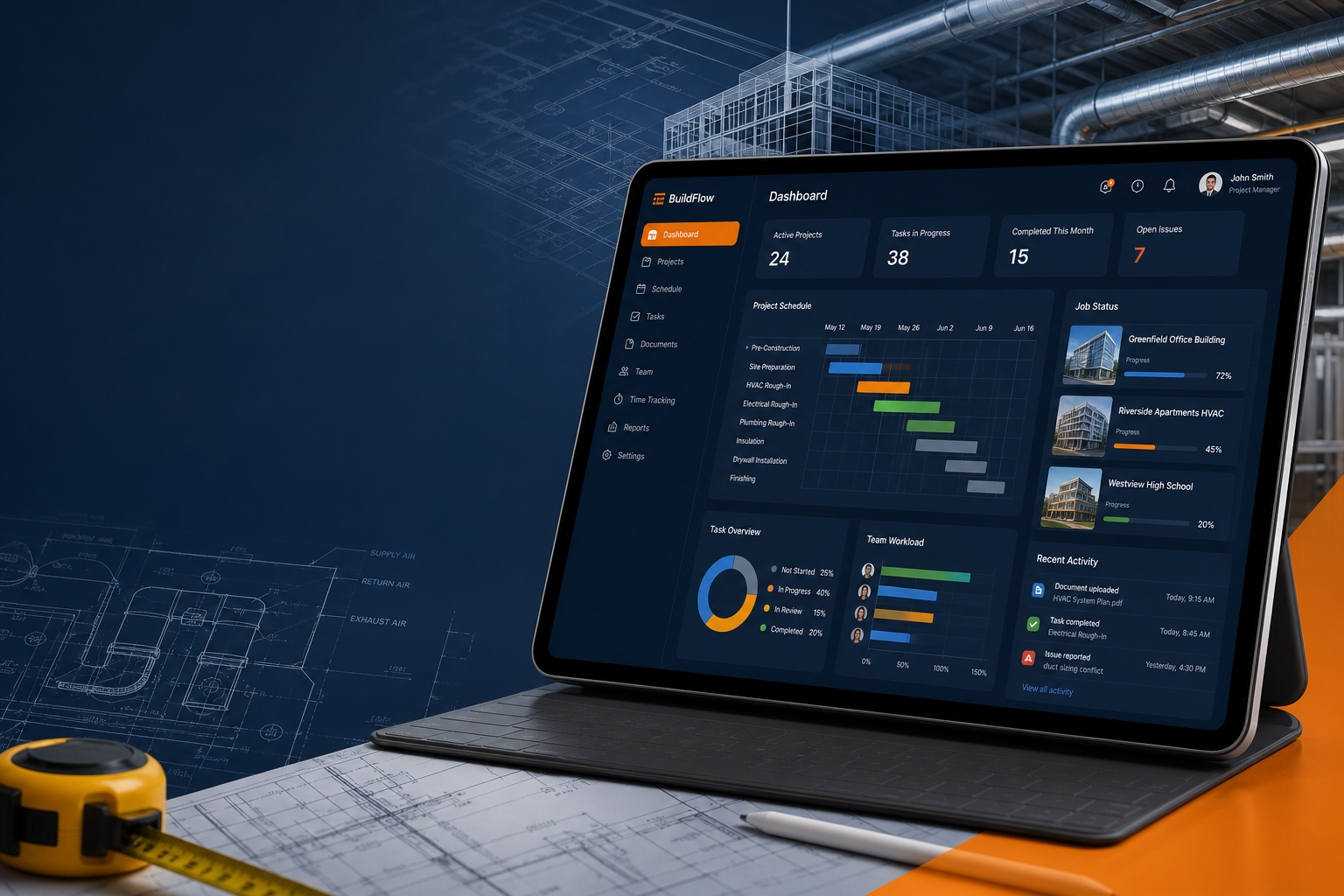
BuildOps occupies a specific lane in contractor software that few platforms fill well: commercial contractor operations. It is not a residential field service app trying to support commercial work through feature additions. It was built from the ground up for HVAC, mechanical, plumbing, and electrical firms that manage dispatch, service agreements, maintenance contracts, project work, and asset tracking across multi-technician teams serving commercial clients.
The distinction matters. A plumbing shop serving homeowners needs online booking, SMS reminders, and consumer-friendly invoicing. A commercial HVAC firm managing maintenance agreements across a hospital campus, a retail chain, and an office tower needs asset histories, multi-day project timelines, AIA billing, and technician dispatch that accounts for equipment lifecycles and permit requirements. BuildOps is built for the second buyer.
This review evaluates whether BuildOps delivers on its commercial positioning, where it falls short, and who should - and should not - invest in a demo and proposal process.
Disclosure: Some links on Contractor Software Hub are affiliate links. If you sign up through one, I may earn a small commission at no extra cost to you. My recommendations do not change based on that.
Right for / Not for
Right for you if:
- You operate a commercial HVAC, mechanical, plumbing, electrical, or fire and life safety contracting business with recurring service agreements and project work
- Your team has 5+ technicians and dedicated office staff who manage dispatch, scheduling, invoicing, and reporting
- You manage multi-location commercial clients and need asset tracking across properties with unified service history
- Recurring service contracts and maintenance agreements are a significant portion of your revenue
- You need AIA progress billing, job costing, and project management that connects to field operations
Not for you if:
- You run a small residential service shop with 1-3 technicians and need a scheduling and invoicing app under $200/month
- You are a solo operator who needs a lightweight mobile-first tool
- Your business is primarily residential with occasional commercial work
- You need consumer-facing features like online booking, customer portal, or SMS marketing
- You cannot commit dedicated personnel to implementation and training
What BuildOps Gets Right
Commercial-First Design
The most important thing to understand about BuildOps is that it was designed for commercial contractors, not retrofitted. The official product pages emphasize workflows that residential-first tools handle awkwardly: asset management across multi-property portfolios, service agreement tracking with renewal automation, multi-day project timelines alongside recurring maintenance schedules, and AIA progress billing. Verified G2 reviewers cite the project-plus-service unification as the most-cited operational benefit - permit fees flow into inventory cost, multi-day project records connect to service ticket history on the same equipment, and pay applications run natively.
For a commercial HVAC or mechanical contractor managing service contracts across a hospital campus, BuildOps’ ability to map every unit to its specific location, stakeholder, and service history is a practical advantage over general field service platforms that treat each job as a standalone event.
OpsAI and Field Intelligence
BuildOps embeds AI capabilities directly into operational workflows through OpsAI rather than selling them as a separate product. The AI provides predictive dispatching based on technician location, skills, and workload. It also automates field documentation - technicians can generate daily reports and service notes through AI-powered note-taking rather than manual entry. The official BuildOps resources page describes this as “eliminating administrative friction” so technicians spend more time on revenue-generating work. The practical benefit for contractors is that OpsAI is included in the platform, not priced as an add-on.
Asset and Customer Hierarchy Management
BuildOps’ asset management capabilities organize data across multiple properties under the same client. This is the feature that most clearly distinguishes it from residential-focused platforms. A commercial HVAC contractor serving a property management firm with 20 buildings can search across all assets at all properties, find the correct contact person, review service history, and dispatch the right technician with the right parts. For contractors managing commercial service agreements, this replaces spreadsheet-based asset tracking that residential tools cannot handle.
Funding and Company Maturity
BuildOps announced a $127 million Series C funding round in March 2025, led by Meritech Capital Partners with participation from BOND and SE Ventures. The announcement stated the round valued the company at $1 billion. For commercial contractors evaluating a platform as their operational backbone, financial stability matters. A company with this funding level, 200+ reviews across review platforms, and stated customer growth is less likely to be acquired and shut down, pivot away from the contractor market, or stop investing in product development. This is a real consideration when choosing between well-funded commercial platforms and early-stage alternatives.
Where BuildOps Falls Short
No Public Pricing
This is the biggest friction point for buyers. BuildOps does not publish a self-serve pricing table. The Access Group comparison page lists it as “pricing available on request.” Official BuildOps resources describe “value-based pricing scaled to your team size and operational complexity.” There is no way to budget for BuildOps without scheduling a demo and receiving a written proposal. This creates a higher evaluation cost than platforms with published tiers. Contractors should be prepared to invest 2-4 weeks in the demo and proposal process before they can compare BuildOps against alternatives with transparent pricing.
Mobile App Quality Concerns
While the mobile app receives strong reviews from some commercial HVAC users who describe the workflow as intuitive, the App Store rating is 3.1 out of 5 based on 381 ratings. Some users report bugs and sync issues. Positive reviews highlight real-time dispatching, GPS navigation, purchase order capture with photo attachments, and AI-powered note-taking. The mixed ratings suggest that mobile reliability depends on the specific workflow, device configuration, and service connectivity. Contractors whose field teams depend heavily on mobile execution should request a trial of the mobile app in their actual working conditions before committing.
Implementation Investment Required
Per G2 and verified reviewer feedback, successful BuildOps implementations require “a person managing the process” alongside training sessions. This is not a tool that a busy owner can deploy over a weekend. Teams without dedicated personnel for implementation, data migration, template setup, and user training face higher risk of adoption failure. Contractors should budget for at least one full-time staff member throughout deployment, plus training time for dispatchers, technicians, and office staff.
Not Built for Residential or Mixed Operations
BuildOps is built for commercial workflows. Plumbing contractors serving both residential and commercial markets report a lack of residential-focused features, according to GetApp reviews. If your business needs consumer-facing scheduling, online booking, SMS marketing, or a customer portal for homeowners, BuildOps is not the right starting point. Platforms like Housecall Pro or Jobber handle the residential side more naturally.
Pricing Breakdown
| Component | Detail |
|---|
| Pricing model | Custom quote (per-user monthly) |
| Published tiers | None |
| How to get pricing | Schedule a demo; receive written proposal |
| Typical buyer profile | Commercial MEP firms with 5+ technicians and office staff |
| What pricing covers | Users, modules, implementation, integrations, support |
| What to confirm in writing | Users, modules, implementation, onboarding, data migration, QuickBooks integration depth, support SLAs, renewal terms, data export rights, cancellation terms |
| Estimated evaluation timeline | 2-4 weeks from demo request to written proposal |
| Free trial | No self-serve trial; demo only |
What you’ll actually pay. Without published pricing, the real cost depends on your team size, module selection, and implementation complexity. G2 reviewers note the platform uses per-user pricing. Based on pricing signals from GetApp (2026 profile), similar commercial platforms, and verified G2 reviewers, commercial MEP firms can expect a multi-thousand-dollar annual commitment. The total also includes setup time: one dedicated staff member for deployment, training sessions for dispatchers and technicians, data migration, and workflow configuration. Budget for the proposal itself and the internal time to evaluate it.
BuildOps emphasizes that “for the modest price you pay for our platform, you get advanced features built-in that our competitors either sell as add-ons or don’t have at all.” Verify this claim against the specific proposal by listing every feature your operation needs and confirming whether it is included in the quoted price or requires additional modules.
What Users Actually Say
BuildOps maintains positive ratings across multiple software review platforms, with scores ranging from 4.2 to 4.6 out of 5 stars. Capterra rates it 4.4 out of 5 based on 177 reviews. GetApp rates it 4.6 out of 5 (110+ reviews). Software Advice rates it 4.5 out of 5 (148 reviews). G2 rates it 4.2 out of 5 (55+ reviews). The App Store rating is 3.1 out of 5 (381 ratings).
Across Capterra, G2, and GetApp, more than 95% of reviews are 4 or 5 stars. Customer support ratings consistently exceed product ratings - 4.8 out of 5 on Capterra and 4.7 out of 5 on Software Advice, suggesting that when the platform works well, the support team responds effectively.
Positive themes from verified reviewers:
- Commercial-specific workflows: “Create and send quotes directly from the field, with customer approval via email, which then converts to work orders and invoices” (G2 reviewer)
- Improved project oversight: “Budgeting, submittal packages, pay applications, and job cost tracking” (Capterra reviewer)
- Responsive support: “BuildOps’ support team is responsive, helpful, and better than competitors” (G2 reviewers); support staff are available 24/7 and valued for urgent field service emergencies
- Onboarding responsiveness: Implementation teams adapt to contractor workflows rather than forcing rigid processes
Critical themes from verified reviewers:
- Implementation requires dedicated personnel: “A person managing the process” alongside training sessions is needed for successful deployment
- Mobile reliability: Some App Store users report bugs and sync delays, contributing to the 3.1/5 rating
- Residential feature gap: Mixed-residential operations report a lack of homeowner-focused features
- Learning curve: The platform’s breadth means users need time to learn all workflows
Third-Party Rating: Capterra users rate BuildOps 4.4 out of 5 based on 177 reviews. G2 users rate it 4.2 out of 5 based on 69 reviews. The gap between platforms likely reflects different reviewer populations - Capterra skews toward SMB and mid-market users, while G2 attracts more IT and enterprise buyers. We use Capterra as the more representative source for the commercial contractor audience.
BuildOps vs. the Competition
| Feature | BuildOps | ServiceTitan | FieldEdge |
|---|
| Target customer | Commercial MEP contractors | Residential + commercial field service | Mid-market residential field service |
| Pricing model | Custom quote | Custom quote (some published entry tiers) | $100/office + $125/tech + setup |
| Commercial workflow | Native (built for this) | Supported (retrofitted) | Limited |
| AIA progress billing | Native | Not standard | Not available |
| Asset management | Multi-property hierarchy | Basic | Basic |
| Mobile app rating | 3.1/5 (App Store) | 4.3/5 (App Store) | 4.1/5 (App Store) |
| Capterra rating | 4.4/5 (177 reviews) | 4.2/5 (550+ reviews) | 4.3/5 (800+ reviews) |
| Funding | $127M Series C ($1B valuation) | $1.4B+ debt/equity | Acquired |
Bottom Line
BuildOps earns its place in the commercial contractor conversation because it solves a real problem: residential-first field service software does not handle commercial MEP operations well. The asset management, multi-property client hierarchies, AIA billing, and OpsAI capabilities give commercial contractors a purpose-built platform instead of workarounds on general field service tools.
The buying decision comes down to three questions. First, is your operation commercial enough? If recurring service contracts, multi-location clients, and project work alongside maintenance are your normal workflow, BuildOps belongs on your demo list. Second, can you invest in the evaluation? Without public pricing, committing to a demo and proposal process is the only way to know if the numbers work. Third, can you staff the implementation? G2 reviewers are consistent: successful deployment requires dedicated personnel.
BuildOps is wrong for the same reasons it is right for others. If your team is small, residential, or needs a lightweight app, this is too much platform. If your mobile-dependent technicians work in areas with poor connectivity and the App Store reviews give you pause, test the mobile app in your actual conditions before buying.
For commercial HVAC, mechanical, plumbing, and electrical firms that are outgrowing residential-first tools and have the operational complexity to justify a proposal-led purchase, BuildOps is worth the demo time.
Best for: Commercial HVAC, mechanical, plumbing, electrical, fire and life safety contractors with multi-technician teams, recurring service agreements, and project work that needs unified operational visibility.
FAQ
Is BuildOps worth it?
Yes, for commercial HVAC, mechanical, plumbing, and electrical contractors that manage service agreements, recurring maintenance, and project work across multi-technician teams. BuildOps delivers dispatch-to-invoice workflow in one platform with strong asset management and OpsAI tools. The value depends on the specific pricing proposal, so buyers should budget time for a demo and written quote before deciding.
How much does BuildOps cost?
BuildOps uses custom quote pricing based on company size, users, and needed modules. The platform does not publish standardized rates publicly. Per-user monthly pricing is the general model. Buyers should ask for written pricing for users, modules, implementation, integrations, data migration, support, renewal, and data export during the demo process.
What are the biggest downsides of BuildOps?
The main downside is the absence of public pricing. Contractors cannot budget for BuildOps without a demo and written proposal. The platform is also heavy for small residential teams. Implementation requires dedicated personnel and significant time investment. The mobile app carries a 3.1/5 rating on the App Store, with some users reporting bugs and sync issues. For mixed residential-commercial operations, BuildOps lacks residential-focused features found in platforms like Housecall Pro or Jobber.
Does BuildOps work with QuickBooks?
Yes. BuildOps integrates with QuickBooks Online. The depth of the integration, including sync direction for invoices, payments, job costing, and customer records, should be confirmed during the demo.
Does BuildOps have a mobile app?
Yes. BuildOps offers a mobile app on iOS and Android with real-time dispatching, GPS navigation, work orders, property notes and documents, purchase order capture with photo attachments, and AI-powered note-taking through OpsAI. The App Store rating is 3.1/5 based on 381 ratings, so test the mobile experience in your actual working conditions.
What is OpsAI in BuildOps?
OpsAI is BuildOps’ AI-powered layer embedded into the platform. It provides predictive dispatching, automated field documentation, and insight generation from operational data. Rather than a separate add-on, OpsAI is built into the dispatch, quoting, and reporting workflows.
Who is BuildOps best for?
BuildOps is built for commercial contractors operating in HVAC, mechanical, plumbing, electrical, and fire and life safety trades. The ideal buyer has recurring service contracts, multi-location commercial clients with asset tracking needs, project work alongside service operations, and enough technicians and office staff to justify a demo-led platform.
Does BuildOps support AIA progress billing?
Yes. AIA progress billing runs natively in BuildOps, which is a meaningful capability for commercial contractors that need pay applications tied to project progress for multi-phase commercial builds with draw schedules.
How does BuildOps compare to ServiceTitan?
ServiceTitan is broader across residential and commercial but enterprise-priced. BuildOps is narrower and purpose-built for commercial MEP contractors. BuildOps’ asset management and customer hierarchy features are stronger for multi-property commercial clients. ServiceTitan has a larger review footprint and some public starting pricing.
What kind of support does BuildOps offer?
BuildOps offers 24/7 customer support. G2 and Capterra reviewers frequently rate support highly, with customer support ratings beating product ratings on multiple platforms (4.8/5 on Capterra, 4.7/5 on Software Advice).
See also: field service software alternatives.
See also: best scheduling software for contractors.
See also: best invoicing software for contractors.
See also: small contractor bookkeeping software.
See also: best estimating software for general contractors.
See also: best proposal software guide.
See also: HVAC software roundup.
See also: plumbing software roundup.
See also: best software for electrical contractors guide.