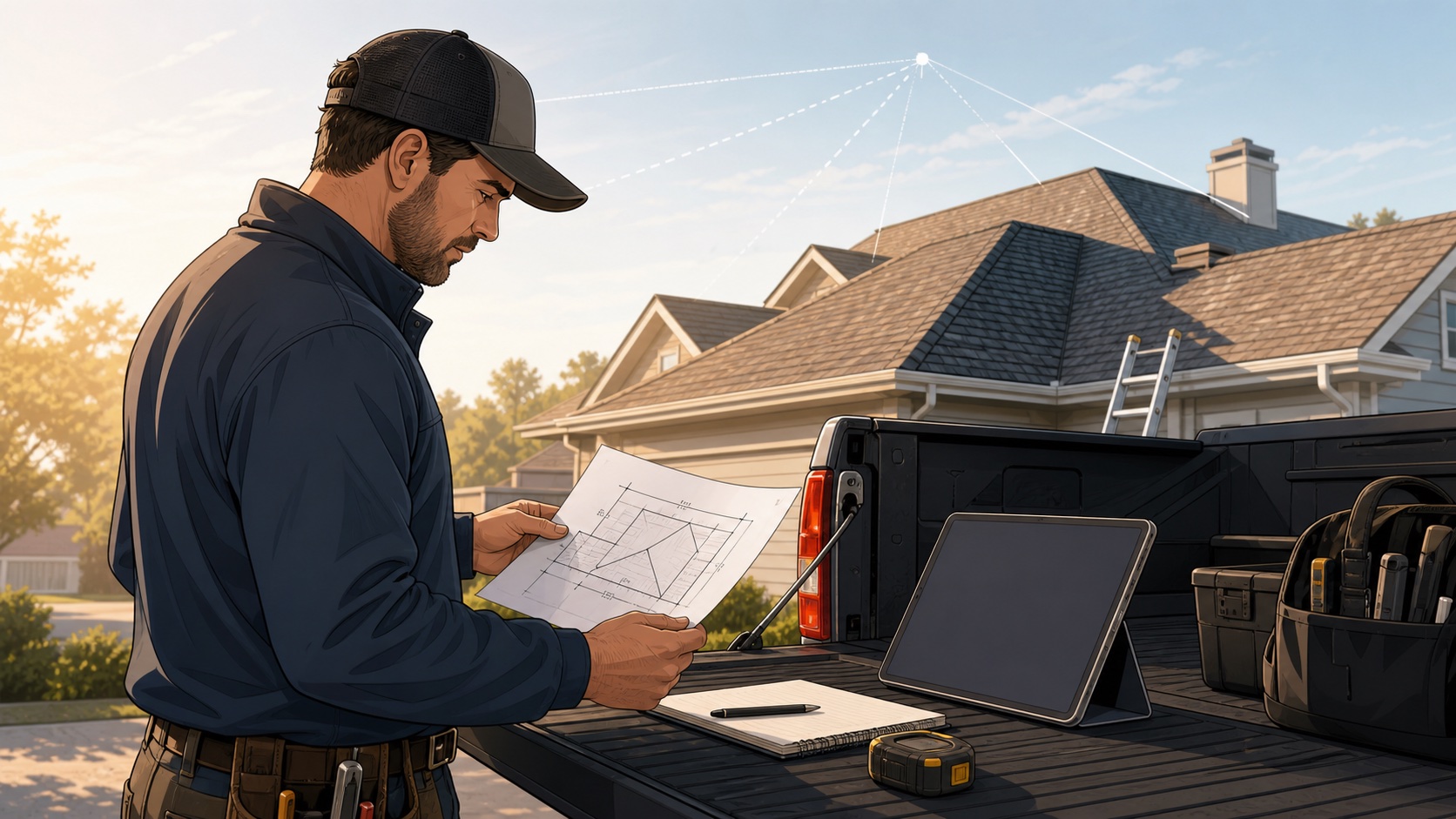
If you sell roofing or siding, EagleView is one of the measurement names everyone knows. It’s not a broad contractor operating system like JobNimbus or AccuLynx. It’s a property data and measurement platform built around aerial imagery, roof reports, siding measurements, and remote job data.
That distinction matters. A roofing CRM helps you track leads, send proposals, manage production, and follow up. EagleView helps you understand the property before you price the work. For some contractors, that measurement confidence is worth the premium. For others, especially simple residential roofers, a cheaper measurement workflow inside Roofr may be enough.
Disclosure: Some links on Contractor Software Hub are affiliate or sponsored links. That never changes the editorial verdict. The goal is simple: decide whether EagleView belongs in your estimating workflow.
Verdict: EagleView is recommended for roofing and siding contractors who need high-confidence remote measurements, especially on complex roofs, commercial work, siding jobs, gutters, and material-ordering workflows. It’s not the best value if you only need fast, low-cost measurements for straightforward residential roofs and want proposals included in the same tool.
Right for EagleView
Right for: Roofing contractors bidding complex residential roofs, commercial jobs, steep pitches, multi-plane rooflines, siding work, and gutter projects where a measurement miss can eat margin. It also fits teams that already use another CRM or estimating platform and simply need trusted property data feeding that workflow.
Not for: Small residential roofers who want one low-cost package for measurements, proposals, e-signature, and lightweight CRM. EagleView can support the measurement side, but it doesn’t give you the full sales workflow by itself.
What EagleView Actually Does
EagleView sells remote property reports built from aerial imagery and property data. The roofing and siding page describes the value plainly: contractors use the data to estimate, order, and deliver without climbing the roof first. The product set covers more than roof area. EagleView publishes report categories for roof measurements, gutter reports, walls, windows, doors, and Full House reports.
That makes EagleView most useful at two points in the roofing sales cycle:
- Early bid work: You need enough roof data to quote quickly, decide whether the job is worth pursuing, and keep sales moving.
- Material ordering: You need more precise measurements before ordering shingles, gutters, siding, or accessories, because waste and shortages cost real money.
EagleView isn’t trying to be your whole business system. You still need somewhere to manage leads, calculate labor, build proposals, assign crews, and invoice. That’s why many roofers use EagleView alongside a CRM, estimating tool, supplier workflow, or production platform. If you are still mapping the broader stack, start with the best roofing takeoff and estimating software guide and the best CRM for roofing contractors guide before buying reports in volume.
Feature Deep Dive
Bid Perfect for quick roof estimates
Bid Perfect is the entry-level roof estimating report. EagleView’s residential property report page describes it as preliminary roof data and measurements for fast roof estimates. The official page lists features such as orthogonal imagery, oblique imagery, pitch distribution, facet count, total roof area in squares, and waste factor for steep-slope work.
The published starting price is $18 per residential report. That gives sales teams a way to create a faster first-pass estimate without sending someone onto the roof immediately. For high-volume residential shops, the question isn’t whether that’s useful. It’s whether the $18 per-report cost beats the measurement tools built into your sales platform.
Premium Roof Reports for ordering confidence
The Premium Roof Report is the more serious measurement report for ordering and production planning. EagleView says it includes total roof area and facets, valleys, pitch diagrams, rakes and eaves, ridges and hips, and more. The official pricing page breaks small, medium, large, and commercial roof reports into speed tiers.
For Small Premium roof reports, official pricing is $32.75 for Bronze, $27.50 for Silver, and $24.25 for Gold. Medium reports are $60, $54.75, and $49. Large reports are $87, $81.25, and $75.50. Commercial reports are $89.50, $84.25, and $79. Platinum requires contacting sales.
The confusing part is that Bronze is the fastest and most expensive tier, Silver sits in the middle, and Gold is the least expensive published tier. Don’t compare an EagleView price without matching the report type and speed tier.
Walls, gutters, windows, doors, and Full House reports
EagleView is often discussed as a roof report company, but the official pricing page shows broader exterior measurement coverage. Gutter Residential reports list at $13.75/report across Bronze, Silver, and Gold. Gutter Commercial reports list at $23.25/report. Walls reports list Residential at $40/report and Commercial at $221.25/report. Walls, Windows & Doors Residential ranges from $78 to $67.50 depending on tier. Full House Residential ranges from $105 to $91.
That matters for roofing companies that also sell siding, gutters, windows, or exterior upgrades. If your average job includes multiple exterior scopes, a roof-only measurement tool may leave gaps. EagleView’s broader report menu gives you a way to measure the whole exterior package from one source.
EagleView One and integrations
EagleView also promotes EagleView One as a subscription-style option for contractors who use EagleView reports. Public pricing isn’t listed, so treat it as a sales conversation rather than a self-serve plan. The roofing and siding page pitches it as a full property intelligence package - you get remote access to measurements, 3D models, imagery, and insights, but you won’t know the cost until you talk to sales.
EagleView says it integrates with construction and project management platforms, and its product navigation includes developer resources and APIs. That’s useful if measurements need to flow into an estimating or CRM workflow, but it isn’t enough by itself. Before buying, confirm the exact integration path with your current software, including what data moves, whether the sync is native, and whether your plan includes it.
What EagleView Gets Right
Measurement trust on complex jobs
The main reason contractors pay for EagleView is confidence. Complex roofs are hard to measure manually, and bad measurements show up later as material waste, supplement friction, missed margins, and callbacks. EagleView’s roofing page says independent studies validate its measurement precision, and it presents remote measurements as a way to reduce waste and avoid job-site measurement time.
That’s the strongest case for EagleView. If your jobs are simple, the premium may feel unnecessary. If your jobs are steep, cut-up, commercial, or multi-scope, accuracy isn’t a nice-to-have feature. It’s part of margin protection.
Clear report menu for different job stages
The separation between Bid Perfect, Premium Roof Reports, gutter reports, wall reports, and Full House reports gives contractors a choice. You can use a cheaper preliminary report during sales and a more detailed report when the job moves closer to ordering. That’s cleaner than paying for the most detailed report every time, especially when many leads won’t close.
Good fit beside existing roofing CRMs
EagleView works best when it feeds another workflow. A company running AccuLynx, JobNimbus, Builder Prime, or another roofing CRM may not need EagleView to manage the customer relationship. It needs trusted measurements to land in the estimating and production process. In that role, EagleView can be valuable without becoming the system of record.
Where EagleView Falls Short
It’s not a full estimating and sales platform
EagleView helps with property data. It doesn’t replace proposal templates, automated follow-up, production boards, customer financing, material supplier ordering, or accounting. If your current problem is that leads are falling through the cracks or proposals take too long to send, EagleView alone won’t fix that. You need a CRM or proposal platform around it.
Per-report pricing adds up
Per-report pricing is easy to understand at low volume and painful at high volume. A contractor ordering 10 Bid Perfect Residential reports spends $180. A contractor ordering 100 spends $1,800 before any Premium, siding, gutter, or commercial reports. Volume discounts may be available through sales, distributors, or integration partners, but you need to model your actual report count before calling EagleView affordable or expensive.
Pricing is detailed but still complicated
EagleView deserves credit for publishing many report prices. The challenge is that buyers still have to map report type, property type, size, speed tier, volume discount, integration partner, and EagleView One subscription terms. Platinum pricing and EagleView One both require sales. That’s normal for enterprise measurement data, but it makes quick budgeting harder for a small shop.
Pricing Breakdown
EagleView’s official pricing page uses per-report pricing. Here are the public numbers contractors are most likely to care about:
| Report type | Published pricing | Notes |
|---|
| Bid Perfect Residential | $18/report | Preliminary roof data for faster estimates |
| Bid Perfect Commercial | $49/report | Commercial bid report pricing differs from residential |
| Premium Roof Small | $24.25-$32.75/report | Gold is least expensive; Bronze is fastest and most expensive |
| Premium Roof Medium | $49-$60/report | Official pricing uses 40 square size reference |
| Premium Roof Large | $75.50-$87/report | For 40+ square reports |
| Premium Roof Commercial | $79-$89.50/report | Separate from residential roof report pricing |
| Gutter Residential | $13.75/report | Same public price across Bronze, Silver, and Gold |
| Walls Residential | $40/report | Exterior wall measurement report |
| Full House Residential | $91-$105/report | Roof, wall, window, and door measurements |
| Platinum / EagleView One | Contact sales | Confirm subscription, volume, and integration terms in writing |
Real budget example: A residential roofing company ordering 40 Bid Perfect reports per month would spend $720/month on those reports before any upgrades. If 15 of those jobs also need Small Premium Roof Reports at the Gold tier, add $363.75. That puts the monthly report spend at $1,083.75 before gutters, siding, Full House reports, or discounts.
That doesn’t mean EagleView is overpriced. The math depends on close rate, report mix, and job size. If one avoided material mistake saves more than the report spend, the tool pays for itself. If most of your work is simple roofs and low-ticket jobs, the same pricing can feel heavy.
EagleView vs. the Competition
| Question | EagleView | Roofr | AccuLynx / JobNimbus |
|---|
| Primary job | Remote property measurements and reports | Measurements, proposals, and lightweight roofing sales workflow | CRM, production, customer management, and job workflow |
| Best fit | Complex roofs, commercial jobs, siding, gutters, and material ordering | Residential roofers who want cheaper reports plus proposals | Roofing companies that need a system of record |
| Pricing model | Per report; EagleView One quote required | Subscription plus report pricing | Monthly software subscription, often with add-ons |
| Main strength | Trusted measurement data | Fast sales workflow for residential roofing | Lead, job, production, and team management |
| Main limitation | Not a CRM or proposal system | Not the same premium choice for complex commercial measurement | Measurement quality depends on integrations and add-ons |
If you only need a measurement vendor, compare EagleView against Roofr, Hover, SkyMeasure, and GAF QuickMeasure. If you need to run the entire roofing business, compare AccuLynx, JobNimbus, and other options in our best roofing software for contractors guide.
Buying Checklist
Before you commit to EagleView, answer these questions with real job counts:
- How many reports will you order each month? Separate Bid Perfect, Premium Roof, commercial, gutter, wall, and Full House reports.
- Which speed tier do you actually need? Bronze costs more than Gold because it’s faster. Don’t pay for speed if your sales process doesn’t need it.
- Do you qualify for volume or partner pricing? EagleView says discounts may be available through integration partners, distributors, or purchase volume.
- Where will the measurements go? Confirm whether EagleView integrates with your CRM, estimator, supplier process, or production workflow.
- What’s your cost of a bad measurement? If one bad order wipes out the report savings from cheaper tools, premium data is easier to justify.
Final Verdict
EagleView is still one of the safest names in roofing measurement. The value isn’t that it’s cheap. It’s that it gives roofers a trusted way to bid, order, and plan without relying on manual roof measurement every time.
Use EagleView when measurement confidence matters more than the lowest report price. That usually means complex residential roofs, commercial work, siding and gutter add-ons, or production workflows where wrong quantities create expensive problems. Skip it, or at least compare hard against Roofr, if your jobs are simple and your bigger need is a proposal and CRM workflow in one place.
Best for: Roofing and siding contractors that want high-confidence remote measurements and are willing to budget per report.