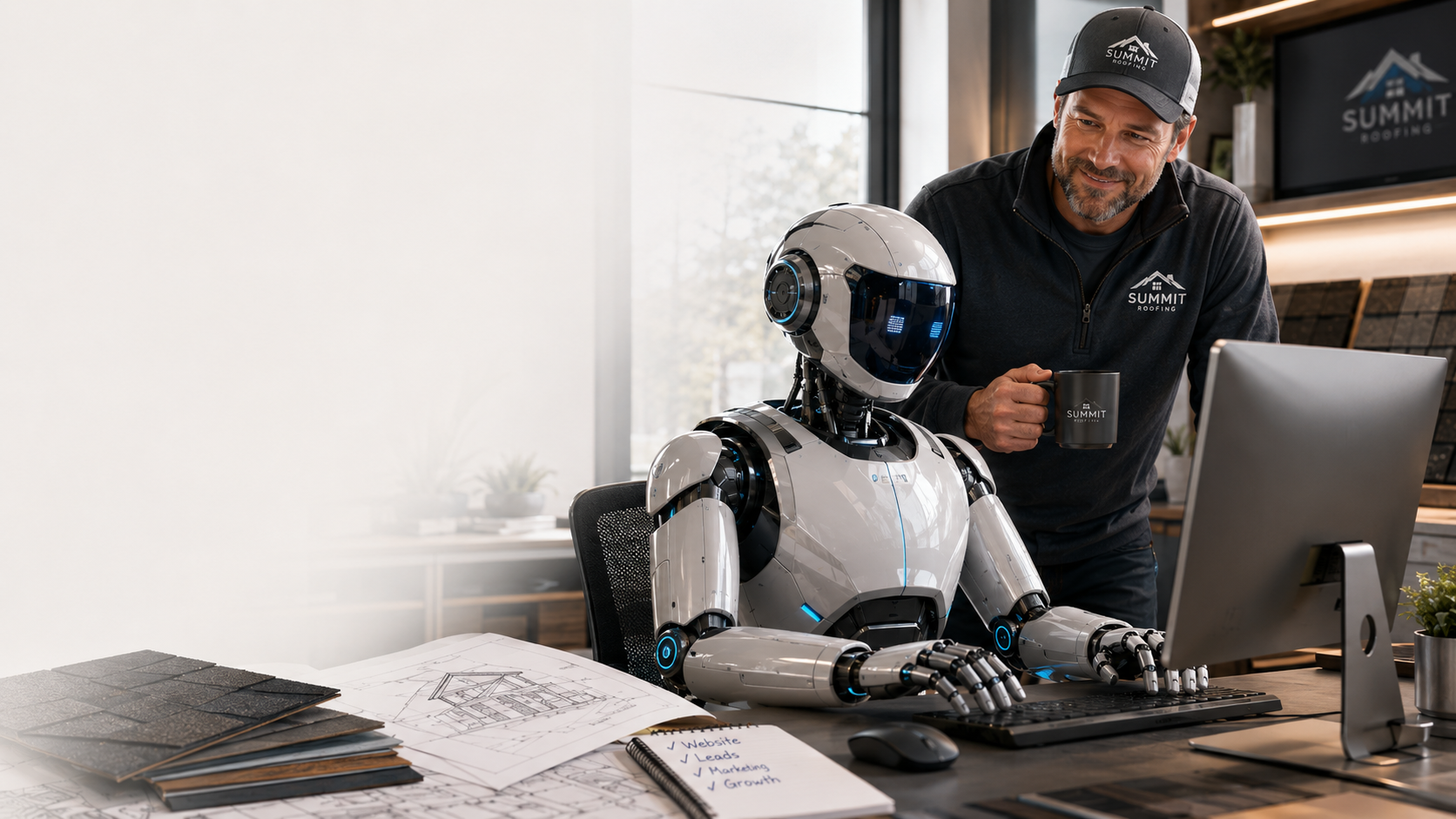
Verdict: Roofclaw is a bold experiment in the “agent-as-employee” model - treating AI not as software, but as specialized employees you hire to handle your biggest business problems: answering calls, scheduling, and customer service. While fewer than 30 companies have deployed it, the philosophy is clear: this is not an AI solution to replace part or all of your stack. Instead, each agent acts like a new hire with your company’s knowledge and industry expertise, with strict role boundaries designed by founder Adam Sand. The trade-off? This high-specificity approach comes at a $10,000 upfront cost. The value proposition is strong domain-specific AI agents that boost your existing employees, but the expense is significant. For traditional roofing software, see our Roofr review and AccuLynx review.
This review is informed by an interview with RoofClaw founder Adam Sand, who walked me through the philosophy, limitations, and roadmap. This is a genuinely new product category: hardware-delivered AI employees, and you are going to see a lot more of this as AI moves from cloud subscriptions to physical appliances that contractors actually own. RoofClaw is early, but the model points toward where the industry is heading.
What Is RoofClaw
RoofClaw takes a different angle on roofing operations: instead of giving you a software subscription, they’re selling you specialized AI employees that act like hired staff. Each agent is configured with your company’s knowledge and Adam Sand’s deep roofing industry expertise, acting as a new hire who knows your business inside and out.
Think of it this way: you’re not buying software that replaces your team. You’re hiring domain-specific AI agents to handle your biggest business problems: answering calls, managing schedules, following up on leads, and serving customers after hours. These agents are configured just like a new employee would be: with your CRM access, your company knowledge, your industry expertise, and your operational preferences.
Adam recommends specific roles for each agent, with those roles acting as boundaries. Similar to how you wouldn’t want someone in Finance running your marketing campaigns, you also wouldn’t want a Marketer making your budget decisions. Each agent has a purpose, a scope, and clear guardrails.
The trade-off? This high-specificity, high-value approach comes at a $10,000 upfront investment, but the philosophy is clear: you’re paying for specialized employee-like AI that acts like a dedicated hire, not for a $1,000/month SaaS tool.
The Value: Strong, domain-specific AI agents that can handle customer calls, manage scheduling, and automate follow-ups with the same expertise as a trained employee.
The Trade-off: This specialized approach costs $10,000 upfront, a significant investment compared to many SaaS tools, but the effectiveness is tied to how well the agent is configured for your specific business needs.
The Problem It Solves
Roofing companies face a critical bottleneck: answering calls and managing customer leads. A lead that doesn’t get a response in 5 minutes is 80% less likely to convert - that’s a 20-year-old statistic from MIT research that still holds up. Your competitors are answering calls 24/7 while you’re not. The subscription trap of 12+ SaaS tools creates another bottleneck.
Roofclaw’s answer: specialized AI employees that act like new hires with your company’s knowledge and industry expertise. They handle your biggest problems: answering customer calls, managing schedules, and following up on leads. They don’t replace your team. They boost your existing employees by handling after-hours work and qualifying leads.
This is the agent-as-employee philosophy in action: each agent is configured with your business knowledge, acting like a dedicated hire who understands your operations.
How It Works
The Hardware
You get a brand-new M5 MacBook Air (24GB) or an M4 Mac Mini. Almost every client picks the Air over the Mac Mini because:
- Built-in UPS (battery keeps it running during power outages)
- Portable: works at job site, in office, or on a plane
- Built-in screen and keyboard for troubleshooting
- Apple Silicon runs AI workloads faster, cooler, and longer than any equivalent Windows machine
Local Models: What’s Possible
A question many technically-minded contractors ask is whether RoofClaw can run local AI models instead of calling cloud APIs. The answer, per Adam Sand, is nuanced:
“The machines that we sell currently are MacBook Airs and Mac Minis, so they do not handle local models much bigger than Gemma 4. Local models are certainly possible with Roofclaw, but we would have to buy bigger hardware. We’re considering launching a larger version, but we were holding out to see what the Mac event shows up with, if there’s a readily available higher RAM machine available, like a MacBook or a Mac Studio with 512 GB of RAM, like before. That would be cool, or we’ve considered offering a DGX Spark, but those are all on the roadmap.”
Sand elaborated that technically it works, but functionally it creates a different experience:
“It can work with local models, but the machine that it goes on isn’t going to host a very big one. We could do something custom, but it’s technically accurate that it can do local models. It’s not functionally accurate, because you have to be much better at prompting and system design to use local models. A lot of the bad prompting and kind of loose instructions can be reduced in its risk by simply not using a local model, but by using a super smart model, and the cost of the hardware would be higher.”
The team is considering larger hardware options like a Mac Studio or even a DGX Spark, but those are on the roadmap, not available today.
The Software
OpenClaw is the open-source agent runtime (roughly 40,000 lines of Rust). RoofClaw wraps it with:
- Roofing-specific configuration
- Pre-built connections to 15+ tools (JobNimbus, CompanyCam, Zuper, AccuLynx, HubSpot, QuickBooks, ProLine, RoofLink, Dialpad, CallRail, Google Ads, Facebook Ads)
- Agent identity built around how you actually work
- Security hardening (FileVault, Tailscale mesh, Secure Enclave)
The Setup Process
- Discovery Form (20-30 min): Learn how you run - tools, team, friction points
- Strategy Call (1 hour): A recorded conversation that becomes the “brain” of your agent. Adam Sand personally does this.
- Building Your Agent (5-7 business days): They configure the Mac, harden it, connect your integrations, load your agent
- Secure Delivery (3-5 business days): Machine ships to your door, configured and ready to plug in
- Activation Call (3 hours): You meet your agent for the first time. Go live together via Zoom screen share
- Ongoing Support: Winning Wednesday weekly group call, Tony mechanic agent, Community Telegram
Total timeline: 2-4 weeks from purchase to live.
What It Actually Does
Primary Use Case: Answering AI
The highest ROI feature is the answering AI - answering customer calls and texts 24/7:
- Screens callers, qualifies against storm data, schedules inspections
- Responds to customer inquiries after hours
- Follows up on leads automatically, which matters most when your contractor scheduling software and CRM are already busy during storm season
- Pings you on Telegram when something needs your eyes
Other Capabilities
- Review Generation: monitors completion, personalizes review requests, auto-replies to reviews
- Proactive Marketing: monitors job status, cross-references hail trail data, sequences neighbor outreach
- Damage Assessment: receives photos, runs AI hail damage detection, generates repair vs. replace recommendation
- Sales Closure: automates contracts, e-signatures, deposits
- Presentation Recorder: records, transcribes, and summarizes every sales pitch
Integrations
Pre-built connections to:
If your tool has an open API, they’ll build a connection during the build phase.
Pricing
$10,000 One-Time
- Brand-new M5 MacBook Air (24GB): yours to keep
- Pre-consult call: map your business, stack, agent identity
- Full OpenClaw build: configured, secured, tested before shipping
- Up to 3 API integrations connected and verified
- 3-hour live training, screen-shared on your machine
- Tony “The Wrench” Clawzini: on-machine AI mechanic agent
- RoofClaw Community: private Telegram with Vito + Adam (6 months free, then $99/mo)
- Winning Wednesday: weekly group webinar, ongoing
Additional Costs
- AI Usage: $50-$300/month (cloud model tokens, billed by the model provider directly)
- Community: $99/month after 6 months free (private Telegram with Vito and Adam)
TCO Comparison
| Product | Year 1 Cost | Ongoing Annual |
|---|
| Roofclaw | $10,000 + ($50-$300 × 12 = $600-$3,600 AI) + $594 (community) = ~$11,200-$14,200 | $600-$3,600 + $1,188 |
| JobNimbus | $1,548 (monthly) | $1,548 |
| CompanyCam | $1,188 (monthly) | $1,188 |
| Podium | $1,788 (monthly) | $1,788 |
| Typical SaaS Stack | $12,000+ (monthly) | $12,000+ |
Break-even: If Roofclaw helps you close one extra $20,000 roof in the first year by following up faster, answering after-hours, or freeing you up to do sales instead of admin. It has more than paid for itself.
Security Architecture
This is where Roofclaw really differentiates itself:
- No internet exposure: no open ports, no public IP, no website to log into
- Tailscale mesh network: private encrypted mesh, locked to your identity
- FileVault disk encryption: on by default before shipping
- Secure Enclave: API keys stored in Apple’s Secure Enclave (same chip as Face ID)
- No Roofclaw access: by design, they can’t log into your machine after shipping
- Password Pusher: one-time credential transfer, self-destructs after single view
- Eubanks security guide: hardening standard before every ship
- Admin/standard account separation: limits damage if someone gets past login screen
The pitch: “Your data stays on your machine. We don’t have a copy. There’s nothing for a hacker to break into on our side because there’s nothing of yours on our side.”
Who Should Buy It
- Roofing companies doing $1M+ in revenue who are losing deals because they can’t answer calls fast enough
- Companies already using 5+ SaaS tools and paying $1,000+/month in subscriptions
- Storm/insurance roofers who need 24/7 lead response
- Companies that value data sovereignty and want their customer data to never leave their office
- Roofers who trust Adam Sand and RBP’s coaching and are willing to book a call, not just buy online
Who Should Skip It
- Small roofing companies just starting out: $10K is too much, and a free CRM for contractors is a safer first step
- Companies not already using multiple SaaS tools: the ROI isn’t there yet
- Anyone looking for a simple chatbot: this is a full agent ecosystem
- Companies that can’t afford a $10K upfront investment
- Technically-minded users expecting large local model support on the current hardware
Final Verdict
Roofclaw is a bold experiment in the agent-as-employee model: physically shipping a pre-configured AI to roofing companies is unlike anything else in this space. The security-first positioning is genuine. The no-subscription model is refreshing. The founder-led approach means Adam Sand brings real roofing credibility to every deployment.
This kind of innovation deserves to be taken seriously - and I genuinely hope RoofClaw succeeds. The repeat buyers expanding their deployments is exactly the signal you want to see at this stage. But with fewer than 30 total deployments and no published case studies, there simply is not enough data yet to call this a proven solution. That is not a knock on the product or the team. It is the honest reality of any genuinely new category.
This is a genuinely new product category: hardware-delivered AI employees, and it signals where the roofing industry is heading. Within a few years, the question will not be “should I buy an AI agent for my roofing business?” but “which one?” RoofClaw has a legitimate claim to being first.
For now, this is a conditional recommendation. Not because I doubt the technology - the agent-as-employee philosophy, the security architecture, and the founder-led approach are all impressive. But because RoofClaw needs more time, more customers, and more case studies before a reviewer can move from “promising” to “proven.” I would love to revisit this article in six months with the data that makes that call easier.
If you are a storm restoration roofer doing over $1M in annual revenue who is actively losing business because calls go unanswered during hail season, the ROI case is compelling enough to book that strategy call with Adam. If you are a smaller shop, a retail-only operation, or anyone not already feeling the pain of missed leads, the $10,000 upfront cost is too much for a product at this stage.
Our rating: CONDITIONAL
This review is based on publicly available information and an interview with RoofClaw founder Adam Sand as of May 2026. RoofClaw pricing and features may change. The approximate customer count reflects public statements and may not be current.